
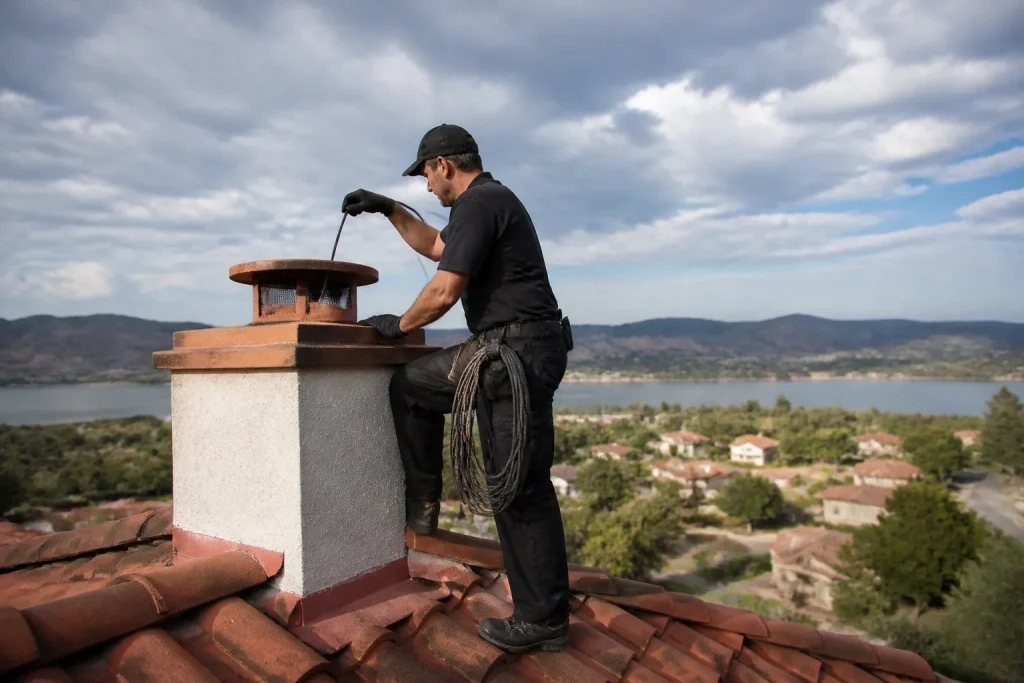
Emergency Chimney Sweep Near Me: What Mission Viejo Homeowners Should Do First
A chimney fire doesn’t always sound like a fire. Sometimes it’s a low roar you mistake for wind in the eaves, or a crackling that sounds like the fire just got a second wind. In our experience, the homeowners who come through a chimney emergency best are the ones who knew what they were hearing and acted in the first few minutes. So here’s the short answer: get everyone out of the room, stop the fire’s air supply, and call. If you’d rather not sort through it alone, call (844) 443-3825 and we’ll walk you through what to do before you hang up.
The order of operations matters more than how fast anyone arrives. Twenty minutes of the right moves buys more safety than a technician who shows up in a hurry and skips the diagnosis. This guide walks Mission Viejo homeowners through the three emergencies that actually happen with wood-burning fireplaces, how to tell them apart, and what a proper follow-up inspection needs to cover.
What Are the Three Most Common Chimney Emergencies in Mission Viejo?
The three emergencies we get called about most are active chimney fires, smoke rolling back into the living space, and animals trapped in the flue. Each has different immediate steps. Confusing one for another is the single biggest mistake we see, because two of the three call for opposite responses.
1. An active chimney fire
You may hear a low rumble, a roar like a distant train, or loud popping. You might see dense smoke from the flue or flames from the top of the chimney. Some chimney fires burn quietly and go out on their own, which is exactly why they’re dangerous: the heat can crack the flue liner without anyone noticing.
- Get people and pets out of the room, and call 911 if you see flames or heavy smoke at the chimney top.
- Close the glass doors or the firebox damper on the stove if you can do it safely. This starves the fire of oxygen.
- Do not put water on it inside the firebox. The thermal shock can crack masonry.
- Move furniture and anything flammable away from the hearth and out of the room.
2. Smoke backdraft into the living space
Smoke rolling out of the fireplace instead of up the chimney usually means a blocked or partially blocked flue, a cold flue that hasn’t warmed up, or negative pressure in the house. The tell is smoke at the firebox, not from the chimney top.
- Open a window or door on the same side of the house as the fireplace to relieve the pressure.
- Leave the damper open. Air needs somewhere to go up and out.
- Put out the fire if the smoke is thick and getting worse, and get the room cleared.
- Don’t run exhaust fans in the kitchen or bathroom while the fireplace is smoking. They pull air the wrong way.
Notice the difference: a chimney fire wants the damper closed; a backdraft wants it open. Getting that backward makes both situations worse. If smoke is filling the room and you can’t tell which situation you’re in, open the window, get people out, and call.
3. An animal in the flue
Scratching, flapping, or chirping from inside the chimney, and sometimes soot or nesting material dropping into the firebox. Don’t light a fire to “flush it out.”
- Keep the fireplace doors closed and don’t open the damper.
- Open windows in the room to give the animal an escape route if it gets out.
- Wait for the animal to leave on its own, or call for help if it won’t.
- Have the flue swept and inspected after any animal intrusion. Nests and debris block the flue and are a fire hazard.
Why Does Closing the Damper Help During a Chimney Fire but Hurt During a Backdraft?
Because a chimney fire is burning inside the flue and feeding on oxygen, and a chimney backdraft is a draft problem where the flue can’t move air. Same lever, opposite purpose.
When a chimney fire is burning, oxygen rising from the firebox feeds it. Closing the damper or the glass doors cuts the air supply and helps it burn out. When smoke is rolling into the room, the flue isn’t drafting. Closing the damper makes it worse by trapping what’s already there. Leave it open, and give the smoke a path out through a cracked window.
We’ve seen plenty of good intentions go sideways here. A homeowner who knows the “close the damper” rule from a fire-safety article and applies it to a block that’s backing smoke into a living room gets a room full of soot and a headache. The question to ask yourself before you touch the damper: is there smoke coming out of the top of the chimney, or out of the firebox? Top means the fire is in the flue. Firebox means the flue isn’t drafting. That’s your cue.
If you’re not sure, don’t guess. Call (844) 443-3825 and describe what you’re seeing. We answer 24/7.
What Should You Tell the Dispatcher When You Call?
When you call a chimney company, you’re talking to someone trained to route your call based on what you describe. The word “emergency” and the phrase “chimney fire” are handled differently. A chimney fire gets treated as a possible structural incident; an emergency sweep is handled as a blocked flue or a backdraft. The difference matters because the first needs an inspection as part of the visit, and the second may just need a sweep.
Here’s what to have ready when you dial:
- Is there smoke or flame at the chimney top, or only inside the house?
- Did you hear a roar, a rumble, or popping?
- Is the fireplace wood-burning or gas?
- Has the chimney been swept in the last year, that you know of?
- Did you call the fire department? If yes, they may need to check for heat in the structure before anything else.
- Your address and the closest cross street in your neighborhood.
For Mission Viejo homes in areas like Lake Mission Viejo, Mission Viejo, or off Alicia Parkway, give the cross street. It helps the technician plan the visit. If the fire department has already been out, tell the dispatcher. Once a fire department has attended, the follow-up call is inspection, not just a sweep.
If your question is about an animal in the flue rather than smoke, say so up front. That’s a different call, and we’ll route it accordingly: we answer 24/7, and fast dispatch from 7am to 7pm, Sunday through Friday.
What Should a Technician Assess After a Chimney Emergency?
A chimney fire can crack a flue liner, warp a damper, or damage the crown without visible damage from the roof. A backdraft can leave soot throughout the flue and reveal a hidden obstruction. An animal intrusion leaves nesting material and damage to the flue. In all three cases, a visual sweep alone isn’t enough. The standard post-incident protocol is a Level 2 inspection, as set out in NFPA 211, which covers the chimney, the firebox, the venting, and the accessible parts of the flue using a camera.
That’s why we offer inspection as a standalone service rather than bundling it into every call. You should be able to book a Level 2 inspection after an incident without also agreeing to a repair on the spot. What you should get from it:
- Camera footage and photos of the flue lining, joints, and any damage found.
- A check of the firebox, damper, crown, and cap.
- A written summary of findings, not a verbal number on the spot.
- A clear statement of what needs to be fixed now, and what can safely wait.
We document what we find before recommending any repair. If the flue needs resurfacing, HeatShield is the material we use for that specialty repair. If the liner needs replacement, we work with DuraFlex and Olympia Chimney components. A cap or crown rebuilt with Gelco or Famco is standard for us. Those are professional-grade products, not hardware-store substitutes, and they’re part of why we treat a chimney as a full system from the firebox up to the crown.
Keep in mind that a chimney that’s survived a fire may still be unsafe to use. Don’t burn again until an inspection clears it. That’s the part homeowners underestimate.
What Are Red Flags in an Emergency Chimney Sweep?
The biggest red flag is speed without diagnosis. A company that shows up fast but skips the post-event structural assessment and goes straight to a repair quote is telling you something about how it works. After a chimney fire, the order should be: secure the situation, inspect, document, then recommend.
- No camera, no inspection, no photos. Just a number.
- A quote given before the flue has been looked at.
- “You need a full reline” without evidence of why.
- Pressure to sign on the spot, especially after a stressful event.
- A technician who can’t describe what they found in plain language.
You should always feel like you can ask “show me” and get a real answer. The estimate should be written and itemized, with the findings behind it. The final price is set by that written estimate, and the estimate itself is free. If a company won’t put it in writing, that’s your answer.
When to call a pro
If you’ve had a chimney fire, any smoke damage, or an animal intrusion, that’s a call. If you just moved into a Mission Viejo home with a fireplace you’ve never used, that’s a call too. Better to know before you light the first fire than after. Our technicians have up to 10 years of experience and we work with the local professional network. You can reach us at (844) 443-3825.
If you suspect an active chimney fire with flames or structural smoke, call 911 first. We’ll be here when the fire department has finished. Monday through Friday and Sundays we dispatch, closed Saturdays.
Related services in Mission Viejo: if you need a routine cleaning after an incident, book a chimney sweep. For firebox or damper damage, see fireplace repair. For liner, crown, or masonry issues, see chimney repair. Our full range of services lives on the Mission Viejo Chimney Sweep Pros page.
The Bottom Line
In the first 20 minutes of a chimney emergency, what you do matters more than what a technician does when they arrive. Get people out, match your damper move to the situation (closed for a chimney fire, open for a backdraft), and call with specific details. After the incident, the next step is a Level 2 inspection with documented findings. A swept chimney and a safe chimney aren’t always the same thing, and post-incident is when that distinction matters most.
If you’re in Mission Viejo and need help, Mission Viejo Chimney Sweep Pros offers free estimates. Call (844) 443-3825. We answer 24/7, with fast dispatch from 7am to 7pm, Sunday through Friday.
Frequently Asked Questions
We don’t quote a number without seeing the chimney. The visit is priced per job by the written estimate, and the estimate itself is free. A blocked flue or a backdraft sweep prices differently from a post-fire inspection with a full Level 2 assessment. The final number is in the written estimate, and nothing is recommended without documented findings you can see. Call (844) 443-3825 for an exact quote.
Call 911 first if you see flames or heavy smoke at the chimney top, or if you smell smoke in the walls or attic. A chimney sweep comes after the fire department has cleared the scene. Once they have, a chimney sweep is the right next call to assess the flue, the liner, and the structure. The two are not substitutes for each other. Call (844) 443-3825 once the fire department has finished.
A sweep removes soot; a Level 2 inspection finds damage. Flue liners can crack under the heat of a chimney fire without any visible signs from the roof. Per NFPA 211, a Level 2 inspection is the standard post-incident protocol, because it uses a camera to look at the full flue. Without it, you can’t know whether the chimney is safe to use again. Call (844) 443-3825 to book an inspection.
Not until a Level 2 inspection has cleared it. Soot and smoke damage don’t tell you whether the liner is intact. Using the fireplace before inspection risks further damage or a second fire. Have it inspected first. Call (844) 443-3825 and we’ll get you on the schedule.
Written by the team at Mission Viejo Chimney Sweep Pros.
Need Chimney Cleaning Help?
Call Mission Viejo Chimney Sweep Pros - the local pro we connect you with is licensed and insured, with free written estimates in Mission Viejo.
(844) 443-3825